Biological Mass Balance
Track BOD removal, biomass growth, decay, volatile/inorganic solids, and net sludge production.
Design and evaluate a conventional activated sludge system using a structured Excel workflow for biological loading, reactor sizing, solids production, sludge wasting, oxygen demand, aeration equipment, and secondary clarifier design.
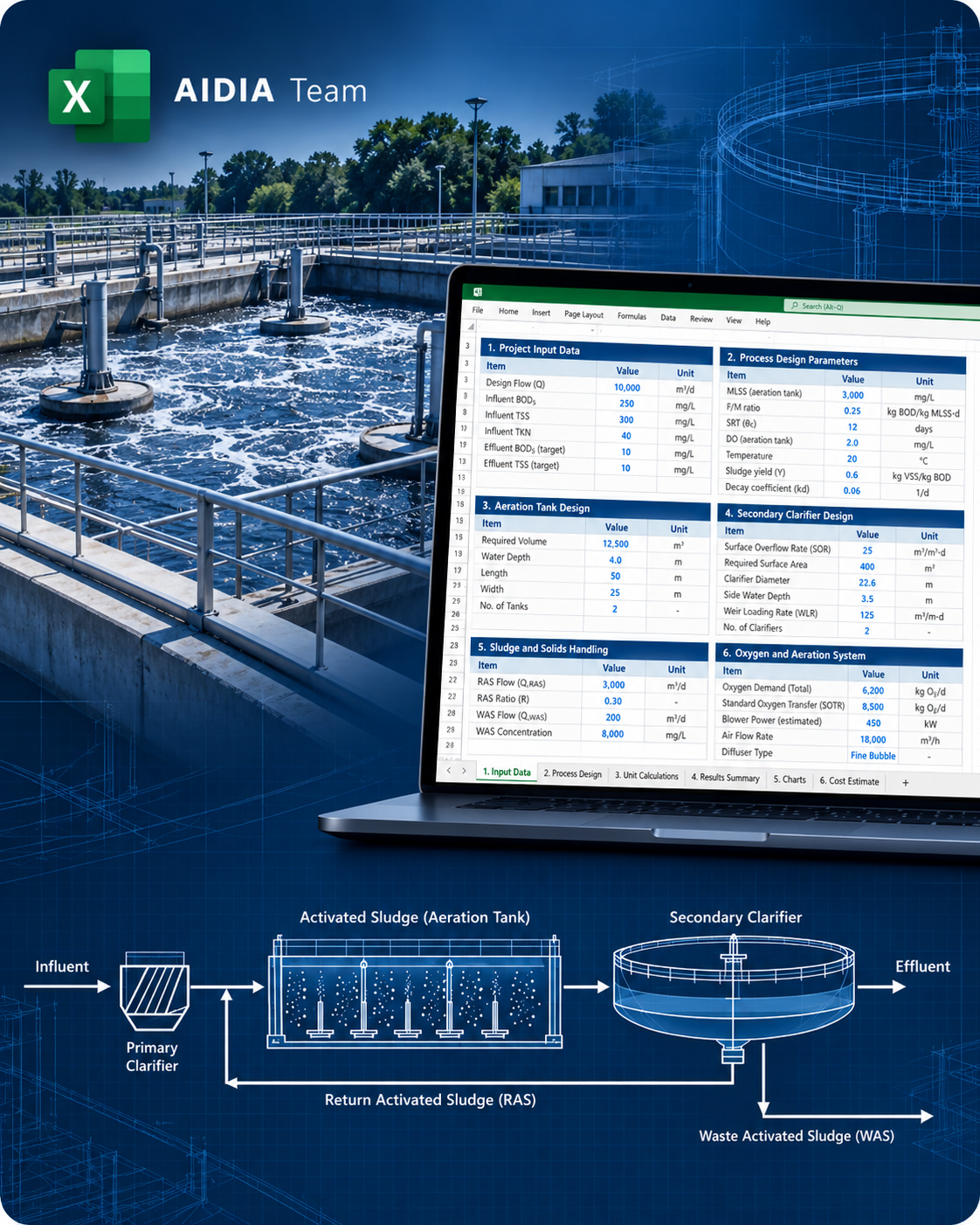
Use one connected process calculation from influent and primary-treatment basis through biological reactor sizing, sludge production, oxygen demand, aeration equipment, RAS/WAS handling, and secondary clarification. The workbook is intended for preliminary conventional activated sludge system design and engineering review.
Track BOD removal, biomass growth, decay, volatile/inorganic solids, and net sludge production.
Size reactor volume and evaluate HRT, F/M, SRT, oxygen demand, and aeration power.
Evaluate settling behavior, hydraulic and solids loading, basin diameter, depth, HRT, and weir loading.
A connected activated-sludge process workflow from influent loading to biological reactor, aeration, sludge recycle/wasting, and final clarification.
Flow, BOD₅, suspended solids, TKN, and upstream primary-treatment removal assumptions.
Soluble/particulate effluent BOD, biological BOD removal, and substrate utilization.
Biomass growth, endogenous decay, VSS/SS balance, and net solids production.
Total reactor volume, number of reactors, plan dimensions, liquid depth, and HRT.
MLVSS, MLSS, F/M ratio, sludge age/SRT, and reactor VSS/SS review.
Return sludge concentration, return ratio, RAS flow, and waste sludge withdrawal from the RAS line.
Carbonaceous, endogenous, and nitrification oxygen demand with field-condition corrections.
Mechanical aeration power and diffused-air alternative airflow/blower power.
Settleability coefficients, HLR/SLR, area, diameter, depth, HRT, and weir loading.
The workbook keeps biological, hydraulic, sludge, and equipment calculations connected in one reviewable sequence.
Define load entering biological treatment.
Size biomass inventory, sludge age, HRT, and oxygen demand.
Separate solids and establish RAS/WAS recycle and wasting basis.
Actual screenshots from the Activated Sludge Design workbook. The preview focuses on the system dashboard and the final design output summary so the workbook structure remains clear without exposing unnecessary calculation detail.
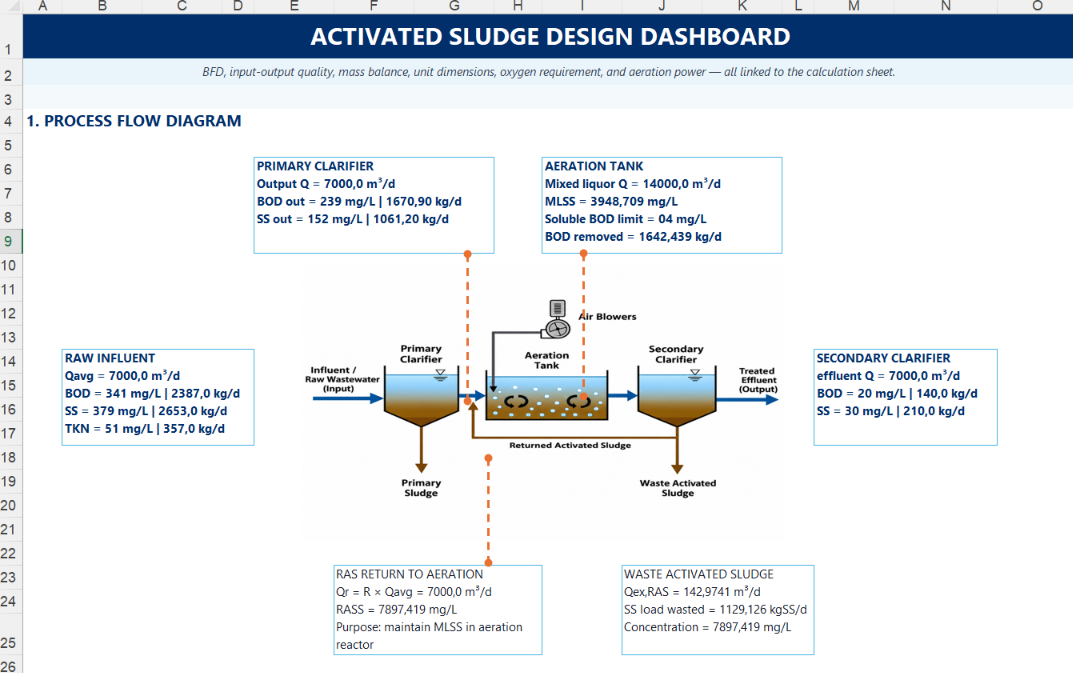
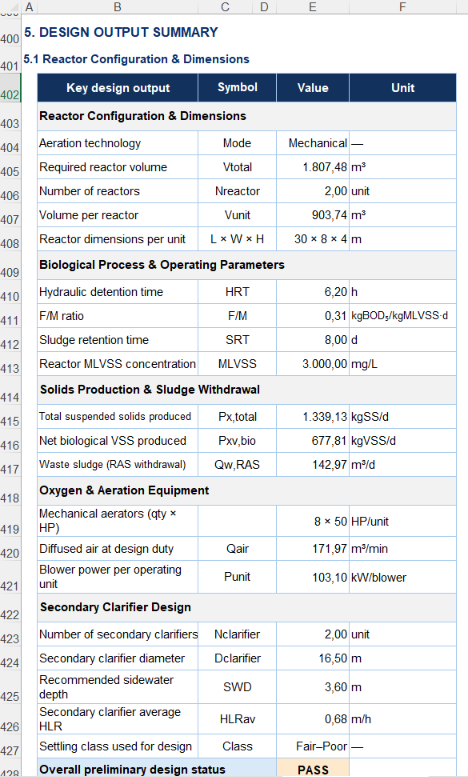
Activated sludge design involves several linked calculations. AIDIA keeps the assumptions, intermediate balances, equipment sizing, and process checks visible in one workflow.
| Design Area | Key Review Output | Engineering Purpose |
|---|---|---|
| Biological loading | BOD and solids balance | Establish reactor substrate and solids basis |
| Reactor operation | MLSS / MLVSS, SRT, HRT, F/M | Review biomass inventory and operating regime |
| Sludge handling | RAS and WAS flow | Maintain reactor solids and waste net production |
| Aeration | Field O₂ demand, SOTR, power / airflow | Translate process demand into equipment duty |
| Secondary clarification | HLR, SLR, diameter, depth, HRT | Verify solids-liquid separation capacity |
Follow the calculation from influent loading to final equipment duty rather than relying on a single unexplained output.
Selected operating and geometry checks are incorporated into the workbook. Detailed numerical criteria remain inside the purchased module.
| Review Item | Workbook Check | Status Style |
|---|---|---|
| Sludge age / SRT | Compared with adopted operating range | PASS / REVIEW |
| MLVSS / MLSS | Reactor biomass concentration review | PASS / REVIEW |
| F/M and HRT | Biological operating check | PASS / REVIEW |
| Oxygen transfer / installed aeration | Process duty vs adopted equipment capacity | PASS / REVIEW |
| Clarifier hydraulic & solids loading | Loading and geometry review | PASS / REVIEW |
A standardized AIDIA workbook structure for biological process design, documentation, and review.
Purpose, use instructions, calculation basis, and engineering responsibility.
Project identity, document information, and revision fields.
Biological process, sludge, oxygen, aeration, and clarifier calculations.
Process flow, mass balance, unit dimensions, oxygen duty, and equipment summary.
Activated sludge and settling criteria used for preliminary review.
Explore AIDIA modules that connect naturally with biological wastewater treatment.
Bring biological loading, reactor sizing, sludge production, oxygen demand, aeration equipment, and secondary clarification into one connected AIDIA Excel workflow.