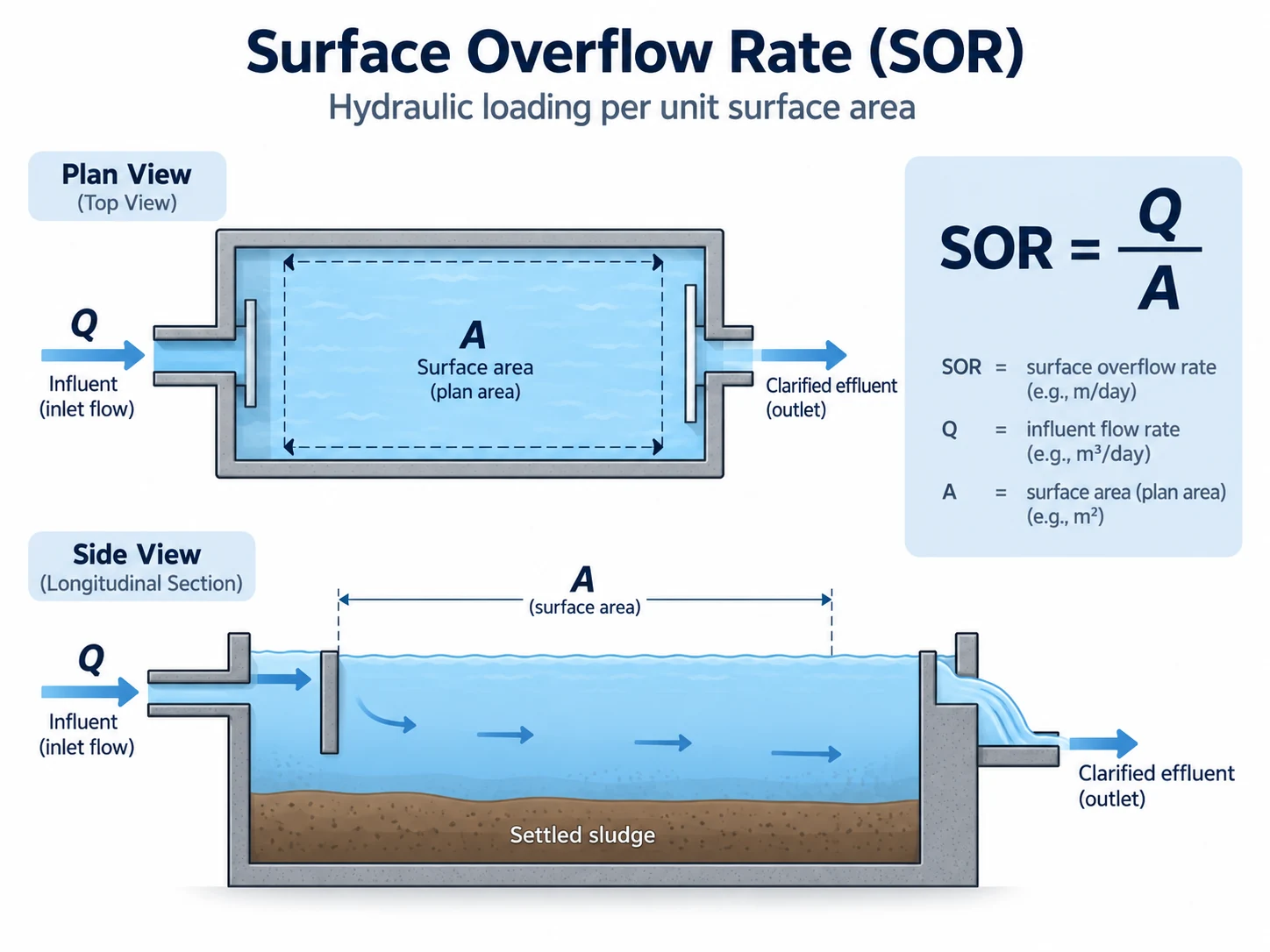
1. What Is Surface Overflow Rate?
Surface Overflow Rate (SOR), also called surface loading rate or overflow rate, is a fundamental parameter used to evaluate the hydraulic loading of sedimentation basins and clarifiers. It represents the volume of water passing through a sedimentation basin per unit of horizontal surface area over a specified time.
In practical terms, SOR indicates the amount of flow that a settling tank must handle relative to the available settling area. It is widely used for conventional WTP sedimentation, primary and secondary wastewater clarification, chemical precipitation, and industrial wastewater settling. Design criteria vary by application.
2. Why Is Surface Overflow Rate Important?
Sedimentation relies on gravity to separate suspended particles from water. As water flows through the basin, particles with sufficient settling velocity move downward into the sludge collection zone.
A lower SOR generally provides more surface area for a given flow and can improve the opportunity for particles to settle. A higher SOR applies more hydraulic loading per unit area and may increase solids carryover. Actual performance also depends on particle behavior, hydraulics, flocculation, sludge inventory and outlet arrangement.
3. Surface Overflow Rate Equation
| Symbol | Description | Typical unit |
|---|---|---|
| SOR | Surface Overflow Rate | m³/m²/day (m/day) |
| Q | Design flow rate | m³/day |
| A | Effective horizontal settling area | m² |
For rectangular sedimentation basins, A = L × W. For circular basins, A = πD² / 4. For identical parallel basins, total effective area is the sum of their areas. Where applicable, account for restrictions or area exclusions required by the selected design methodology.
4. Relationship Between SOR and Particle Settling
Under ideal discrete-particle settling theory, a particle is theoretically fully removed if its settling velocity is at least equal to the surface overflow rate. Real basins may depart from ideal behavior due to flocculation, turbulence, density currents, short-circuiting and sludge blanket effects.
Settling velocity ≥ SOR → theoretical complete removal
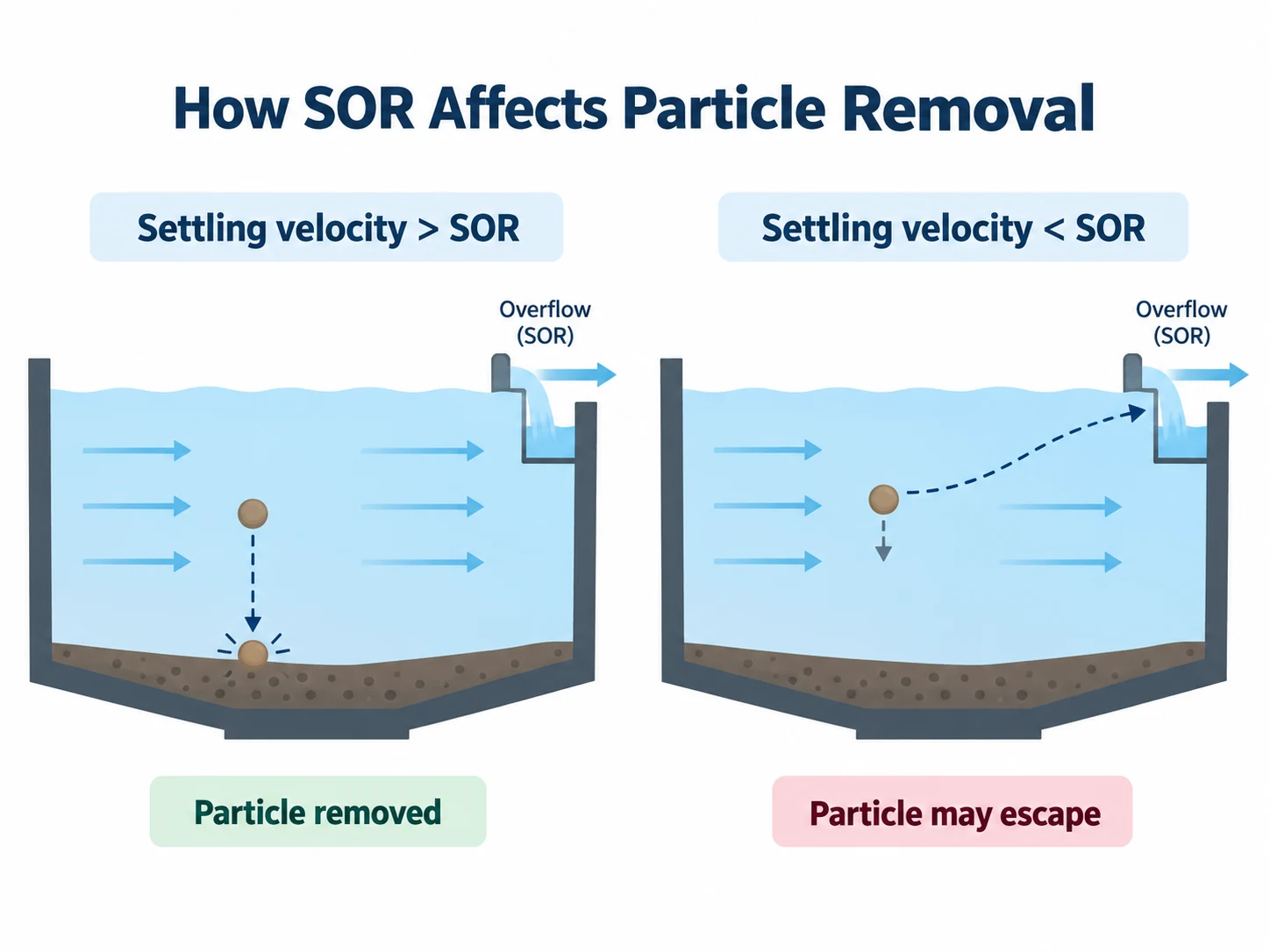
For example, a particle settling at 1.5 m/h may be captured in an ideal basin with SOR = 1.0 m/h. At SOR = 2.0 m/h, complete removal of that particle cannot be assumed. These are theoretical comparisons rather than guaranteed field performance.
5. Example Calculation
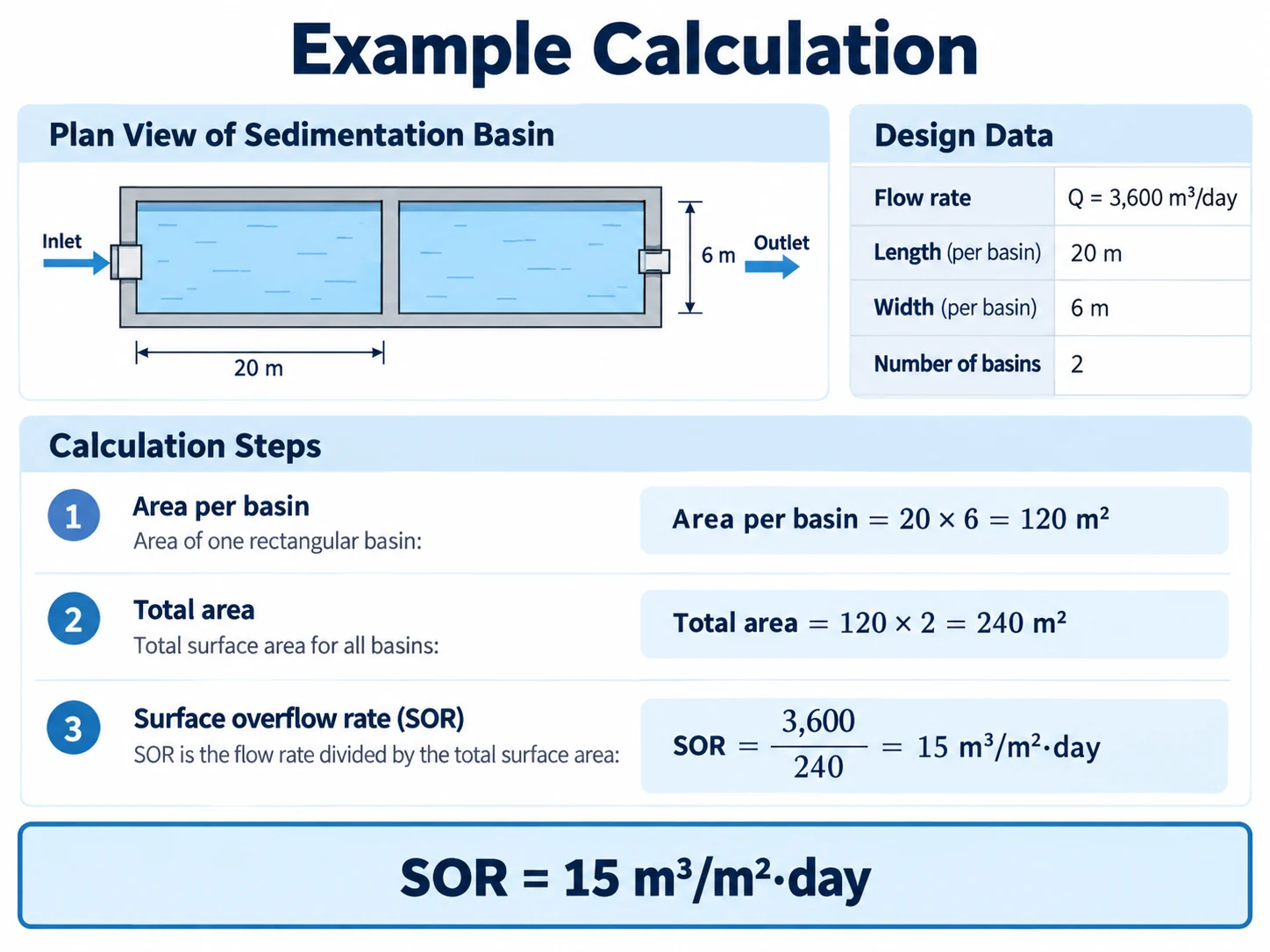
Consider two identical rectangular sedimentation basins operating in parallel with a combined design flow of 3,600 m³/day.
| Design parameter | Value |
|---|---|
| Total design flow rate | 3,600 m³/day |
| Length of each basin | 20 m |
| Width of each basin | 6 m |
| Number of operating basins | 2 |
Each square meter of effective settling surface receives a hydraulic flow of 15 m³ per day. The calculated SOR must then be checked against the criteria applicable to the specific water treatment or clarification process.
6. Does Increasing Basin Depth Improve SOR?
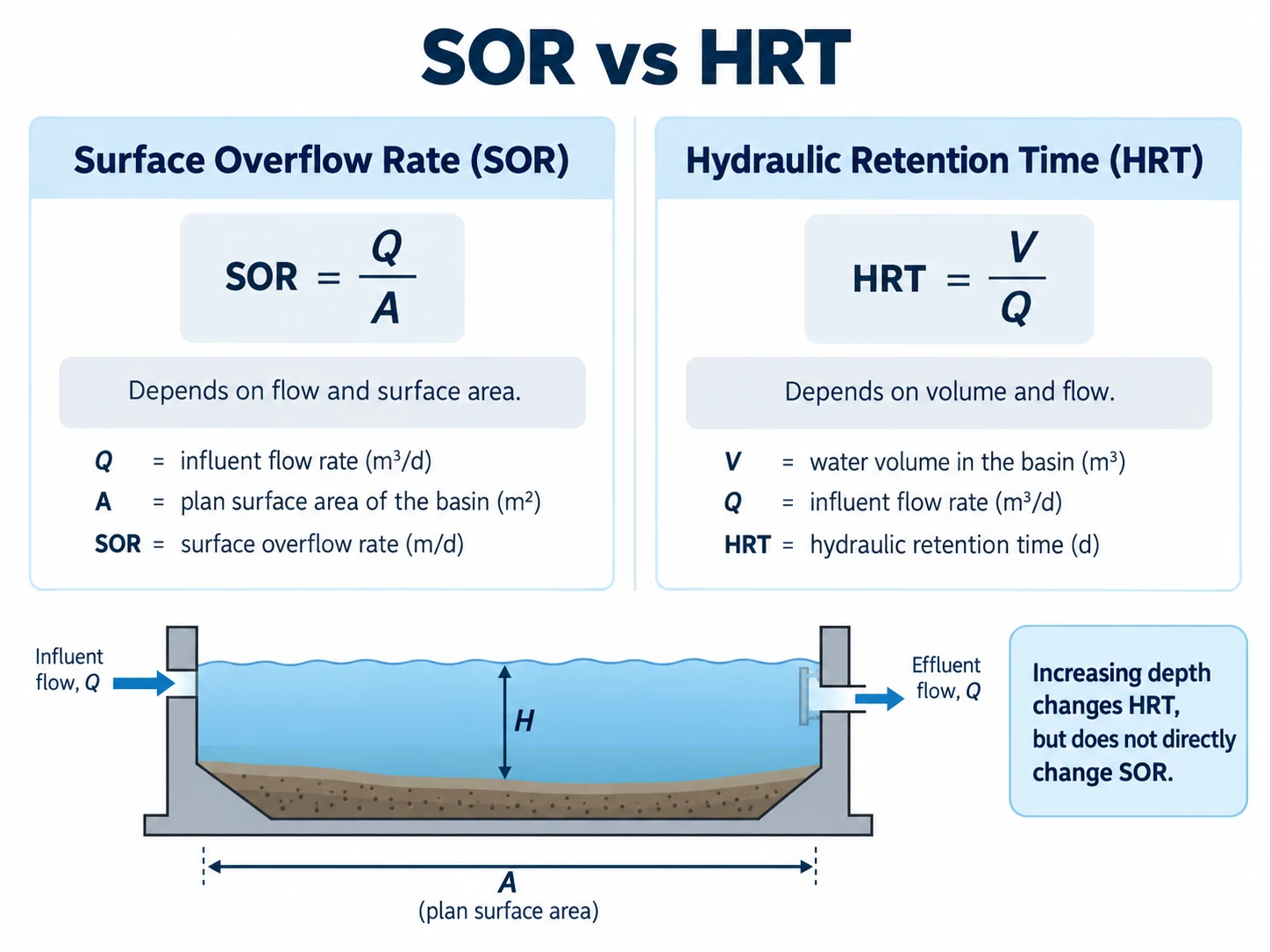
Increasing water depth without changing the flow rate or plan area does not change SOR, because SOR = Q/A. Depth remains important to hydraulic retention time, sludge storage, flow stability, separation between the settling and sludge zones, and sludge removal. Surface area and tank depth address different aspects of design.
7. SOR vs. Hydraulic Retention Time
SOR measures flow per unit surface area, whereas Hydraulic Retention Time (HRT) measures the theoretical average time water remains in the basin.
For a tank with uniform water depth H and consistent units, HRT = H / SOR. For instance, a 3 m deep basin operating at SOR = 1 m/h has a theoretical HRT of 3 hours. Actual residence times may differ because of non-uniform hydraulics.
8. Important Design Considerations
9. Common Engineering Mistakes
10. Conclusion
Surface Overflow Rate is a fundamental sedimentation design parameter linking flow rate to horizontal settling area. Proper basin design requires more than meeting a nominal SOR: it also requires consideration of particle settling, hydraulic behavior, HRT, solids loading, effluent collection and sludge removal. Applicable project standards and qualified engineering review remain essential.
Engineering References
- U.S. Environmental Protection Agency (EPA). Critical Literature Review and Research Needed on Activated Sludge Secondary Clarifiers.
- U.S. Environmental Protection Agency (EPA). Effectiveness of Surface Mine Sedimentation Ponds.
- Voutchkov, N. (2005). Settling Tanks. Water Encyclopedia. Wiley. DOI: 10.1002/047147844X.mw506.
- Ratnayaka, D. D., Brandt, M. J., and Johnson, K. M. Twort’s Water Supply. Elsevier.