1. What Is a Gravity Thickener?
A gravity thickener is a sludge treatment unit that concentrates sludge by allowing suspended solids to settle under gravity. Unlike conventional sedimentation basins, which primarily produce clarified water, thickeners aim to increase the dry-solids concentration of the underflow while separating excess liquid.
They are used in municipal wastewater treatment, water-treatment residuals handling, industrial wastewater facilities, and sludge dewatering systems. Increasing solids concentration reduces the volume that must be stored, pumped, conditioned, or dewatered.
2. How Does a Gravity Thickener Work?
Sludge enters through a central feed well that distributes flow and limits turbulence. Solids settle to form a sludge blanket, become more concentrated through hindered and compression settling, and are moved by a slowly rotating rake toward a bottom withdrawal point. The separated liquid flows to a peripheral overflow launder.
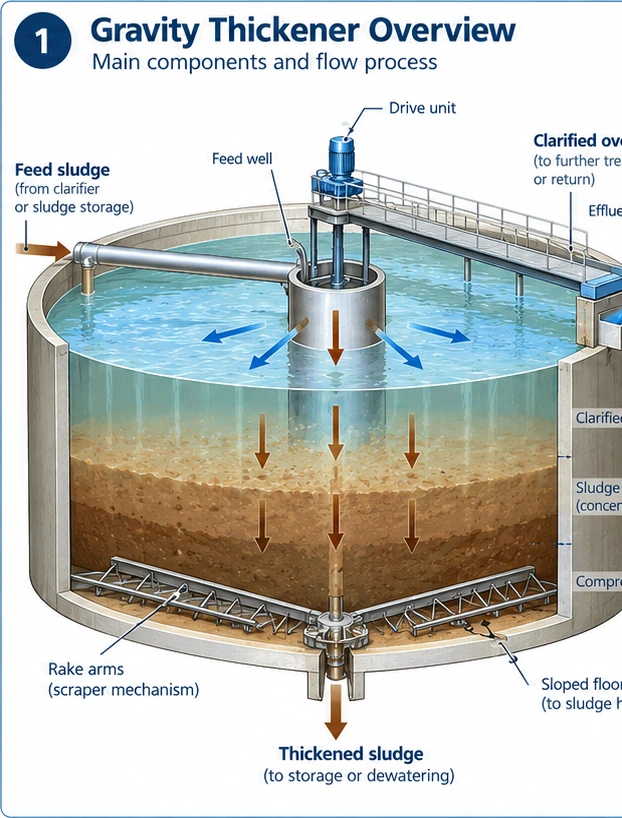
Effective operation depends on the balance between feed solids, settling and compression, sludge inventory, and continuous or intermittent underflow withdrawal.
3. Key Gravity Thickener Design Criteria
3.1 Solids Loading Rate (SLR)
Solids loading rate indicates how much dry-solids mass is introduced relative to the effective tank surface area. It is a primary capacity consideration because the thickener must provide enough settling and compression capacity to manage the incoming solids.
3.2 Hydraulic Loading Rate (HLR)
Hydraulic loading rate describes the volume of sludge feed handled relative to the effective settling area. Hydraulic capacity should be checked independently from solids capacity.
3.3 Sludge Solids Concentration
Engineers assess both feed concentration and desired thickened-sludge concentration. Achievable underflow concentration is sludge-specific and should be supported by testing, operating data, or suitable guidance.
3.4 Sludge Retention Time
Solids retention must allow sufficient thickening without promoting septic conditions, gas formation, or odor. This differs from hydraulic retention of the liquid phase.
3.5 Tank Depth and Sludge Blanket Depth
Tank depth provides space for clarification, sludge compression, sludge accumulation, floor slope, and mechanical equipment. Sludge blanket monitoring helps operators maintain stable thickening and prevent solids carryover. Increasing depth alone does not solve excessive surface loading.
4. Gravity Thickener Design Methodology
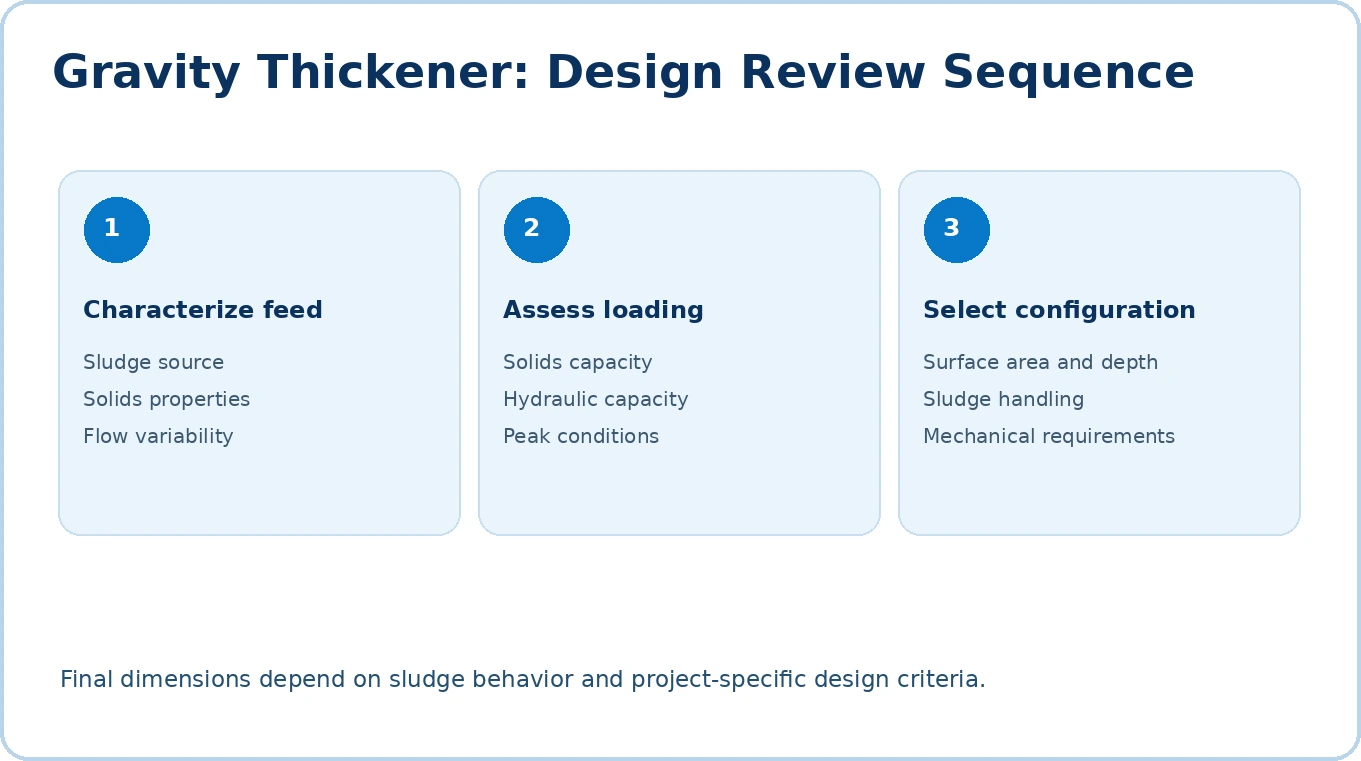
Gravity thickener design follows a series of connected engineering decisions. Each stage builds on information established in the previous stage and should be checked against the intended sludge service.
5. Understanding Sludge Volume Reduction
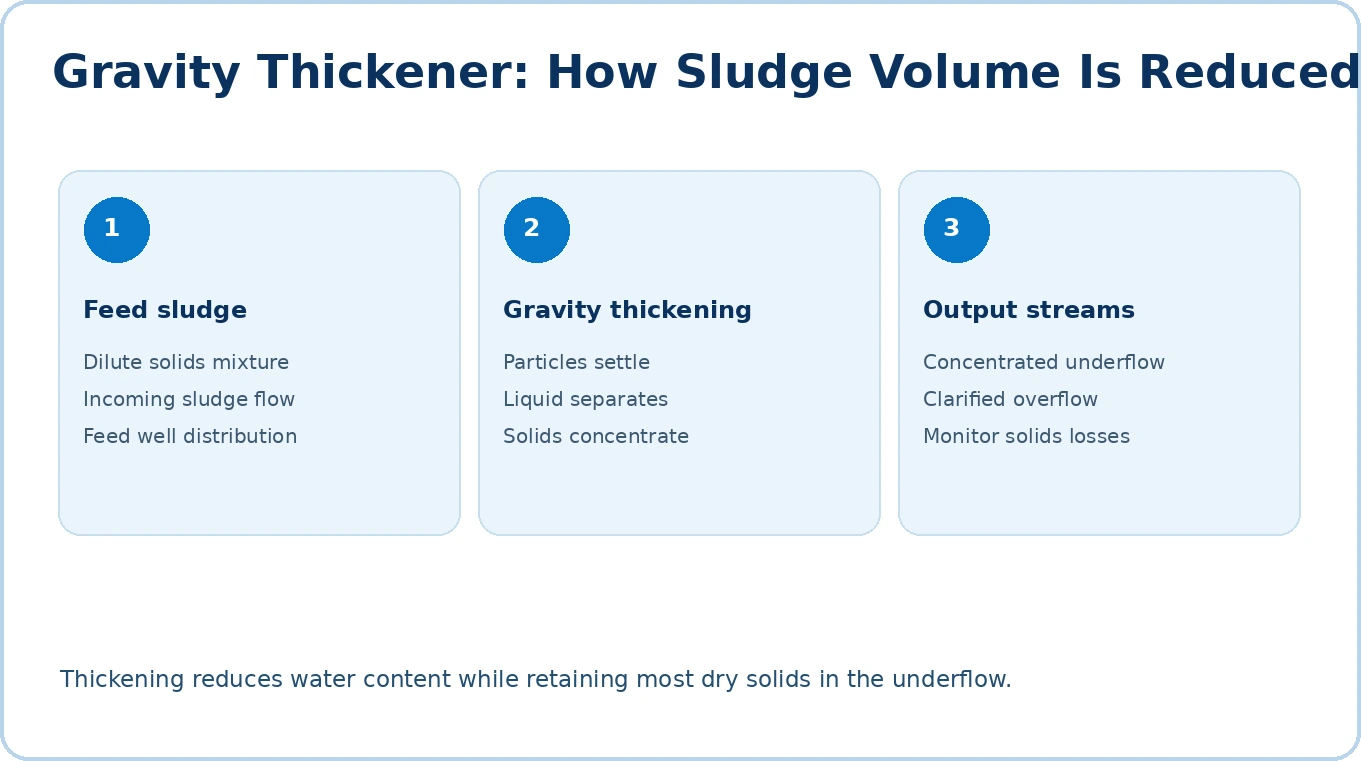
Gravity thickening reduces the volume of sludge requiring downstream handling by separating part of its water content. The dry solids are intended to remain primarily in the thickened underflow, while the separated liquid exits through the overflow.
Designers first establish the incoming dry-solids quantity and feed concentration, then estimate a realistic thickened-sludge concentration for the actual sludge. This allows them to evaluate expected underflow volume and downstream storage or dewatering requirements.
Any solids escaping with the overflow should be considered, particularly where the overflow is returned to an upstream treatment unit. Actual volume reduction depends on sludge behavior, solids capture, density, and operating controls; it should not be treated as a guaranteed fixed percentage.
6. Design Factors Affecting Thickener Performance
7. Common Gravity Thickener Design Mistakes
8. Conclusion
Gravity thickener performance depends on sludge properties, solids and hydraulic demands, sludge inventory, operating depth, withdrawal control, and mechanical capability. A reliable design follows a clear evaluation sequence and verifies operating conditions, solids capture, and downstream handling requirements against sludge-specific evidence.
9. Engineering References
- U.S. Environmental Protection Agency (EPA). Process Design Manual for Sludge Treatment and Disposal. EPA 625/1-79-011 (1979).
- U.S. Environmental Protection Agency (EPA). Gravity Thickening, Biosolids Technology Fact Sheet. EPA 832-F-03-022 (2003).
- U.S. Environmental Protection Agency (EPA). Drinking Water Treatment Plant Residuals Management Technical Report (2011).
- Water Environment Federation (WEF). Thickening 101 (2022).
This article provides educational and preliminary engineering guidance. Loading criteria and achievable underflow concentrations must be selected for the actual sludge; final design should be checked against applicable references, project specifications, plant data, and qualified engineering review.