Upstream BOD Removal
Remove the majority of incoming biodegradable organic load using a dedicated carrier-media stage.
Design a staged moving bed biofilm reactor system using a structured Excel workflow for upstream BOD removal, BOD polishing, two-stage nitrification, carrier-media sizing, reactor dimensions, and linked process review.
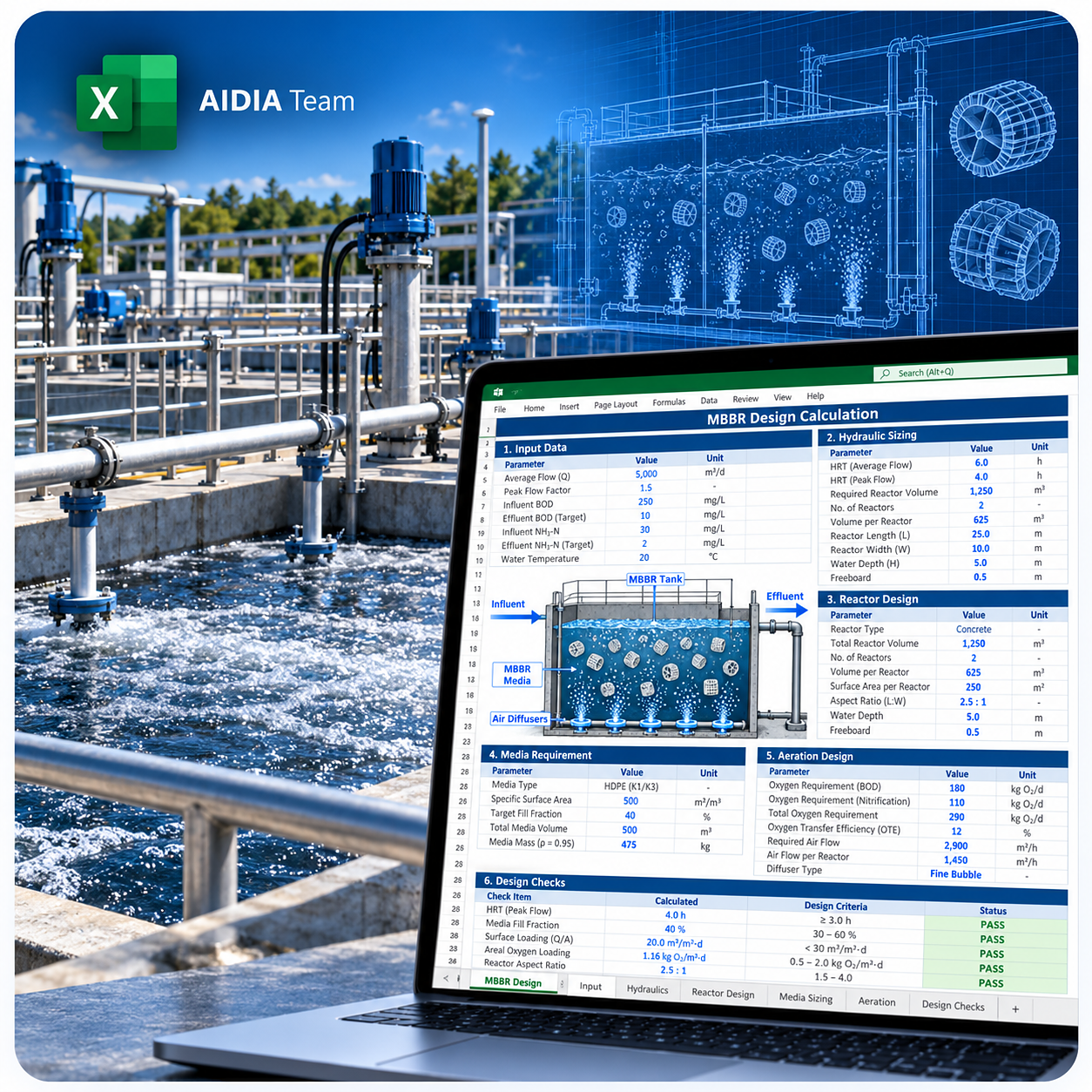
Build a staged MBBR train from influent design basis through BOD removal, nitrification media sizing, and practical physical tank dimensions.
Remove the majority of incoming biodegradable organic load using a dedicated carrier-media stage.
Reduce residual organic matter ahead of nitrification to limit competition for oxygen and biofilm area.
Size the first nitrification reactor from ammonia load, temperature, DO, and carrier-media flux.
Polish the remaining ammonia load to the selected final effluent target.
Track BOD load through the upstream and polishing stages.
Calculate required carrier surface area from the selected process basis.
Convert required carrier area into media volume using the selected SSA.
Review required and constructed liquid volume and total train HRT.
Evaluate DO- and NH₄-limited flux and stage-specific ammonia removal.
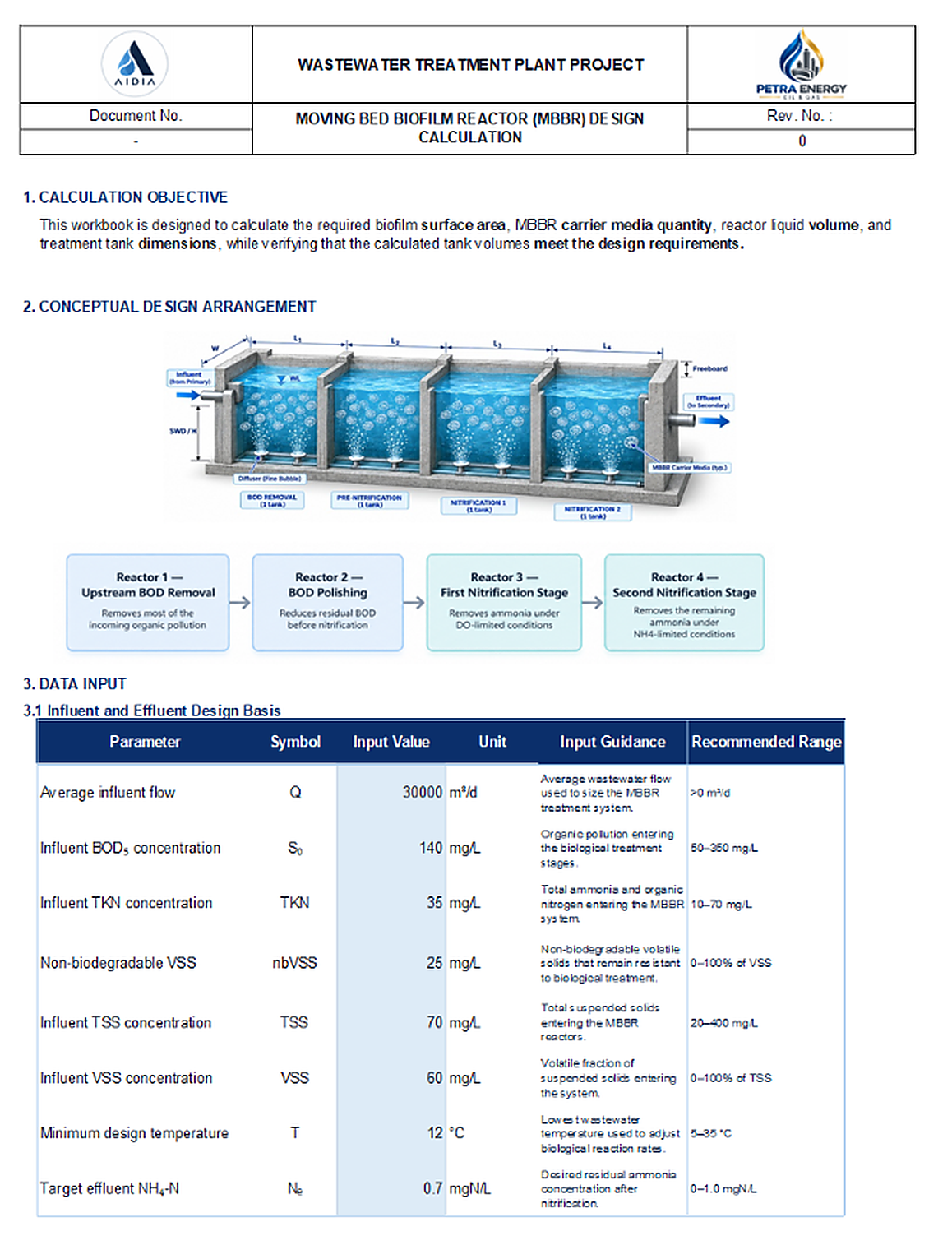
A connected sequence from influent design basis to a practical four-tank MBBR system.
Flow, BOD, TKN, solids, temperature, and target effluent NH₄-N.
Determine biofilm area, media quantity, reactor volume, and HRT.
Reduce residual BOD before nitrification.
Size carrier media and reactor capacity for the first ammonia-removal stage.
Complete ammonia polishing to the final target.
Confirm actual volume, tank dimensions, HRT, media fill, and flux checks.
Actual screenshots from the MBBR Design workbook. Public previews show the workbook structure and linked outputs without exposing the full calculation logic.
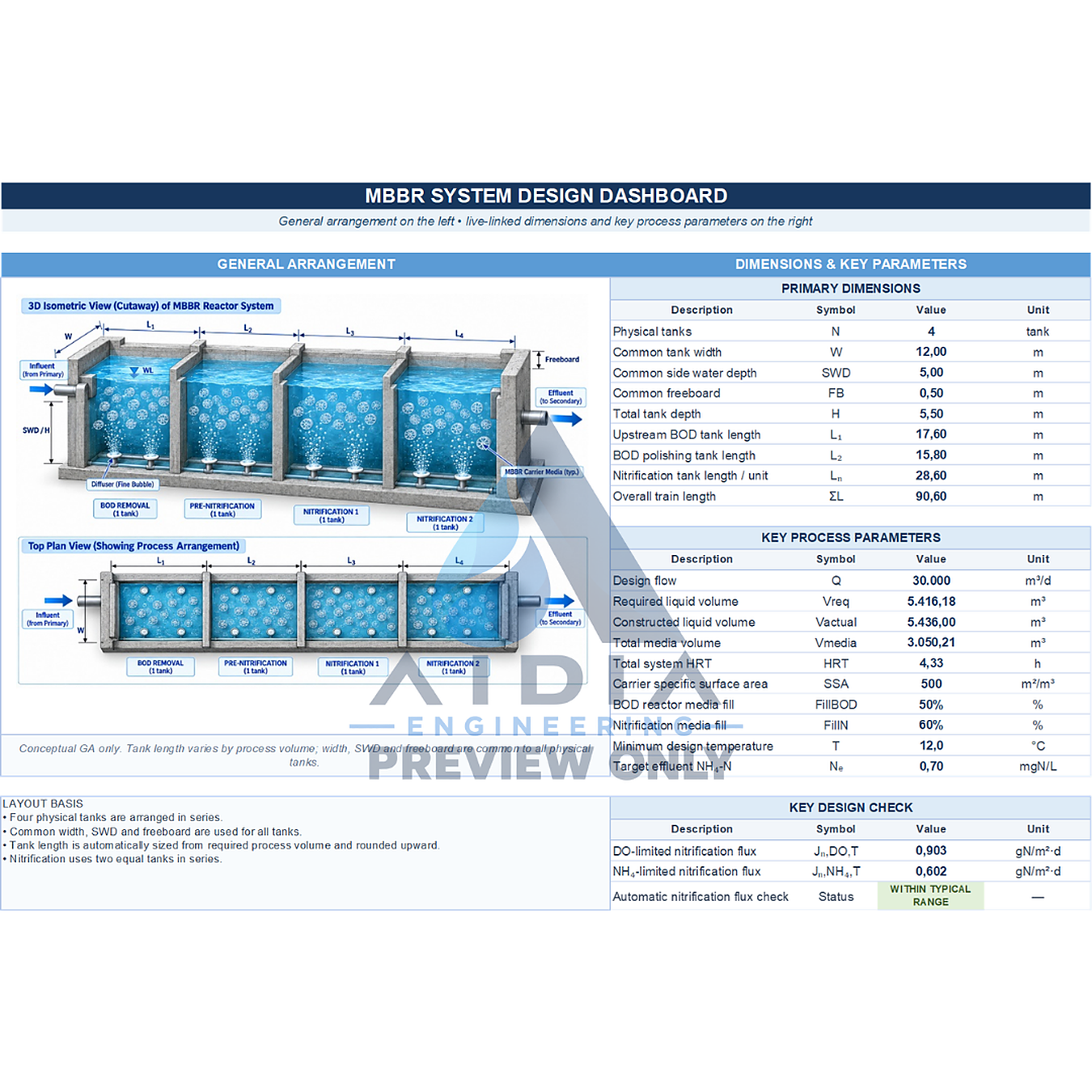
MBBR design links biological loading, carrier-media requirements, nitrification capacity, and physical tank dimensions. The workbook keeps those stages tied to the same design basis.
| Design Area | Key Review Output | Engineering Purpose |
|---|---|---|
| Influent design basis | Flow, BOD₅, TKN, solids, temperature | Define the loading entering the staged biological system |
| BOD removal stages | Carrier area, media volume, reactor volume | Establish upstream organic-removal capacity |
| Nitrification | DO/NH₄-limited flux and media requirement | Confirm ammonia-removal capacity under the selected basis |
| Hydraulic sizing | Required vs constructed liquid volume and HRT | Translate biological demand into practical reactor volume |
| Physical train | Tank width, depth, freeboard, stage lengths | Develop a consistent four-tank arrangement |
| System review | Media fill, capacity margin, geometry and flux checks | Identify conditions that need engineering review |
The public page shows the design path without publishing the complete calculation method or detailed proprietary workbook logic.
Flow, organic load, nitrogen load, temperature, and effluent target.
Biofilm carrier area, media volume, liquid volume, HRT, and nitrification capacity.
Four-tank arrangement, stage lengths, actual volume, media inventory, and linked dashboard.
A standardized AIDIA workbook structure for staged MBBR process calculation and engineering review.
Purpose, scope, assumptions, responsibility, and user guidance.
Project information, document identity, and revision fields.
Stage sizing, carrier-media requirement, nitrification capacity, geometry, and checks.
Linked system arrangement, dimensions, key process parameters, and flux review.
Engineering symbols, notation, and units used throughout the workbook.
Explore other AIDIA modules for biological wastewater-treatment design.
Bring staged BOD removal, carrier-media sizing, nitrification capacity, reactor dimensions, and process review into one connected AIDIA Excel workflow.