1. What Is Hydraulic Retention Time?
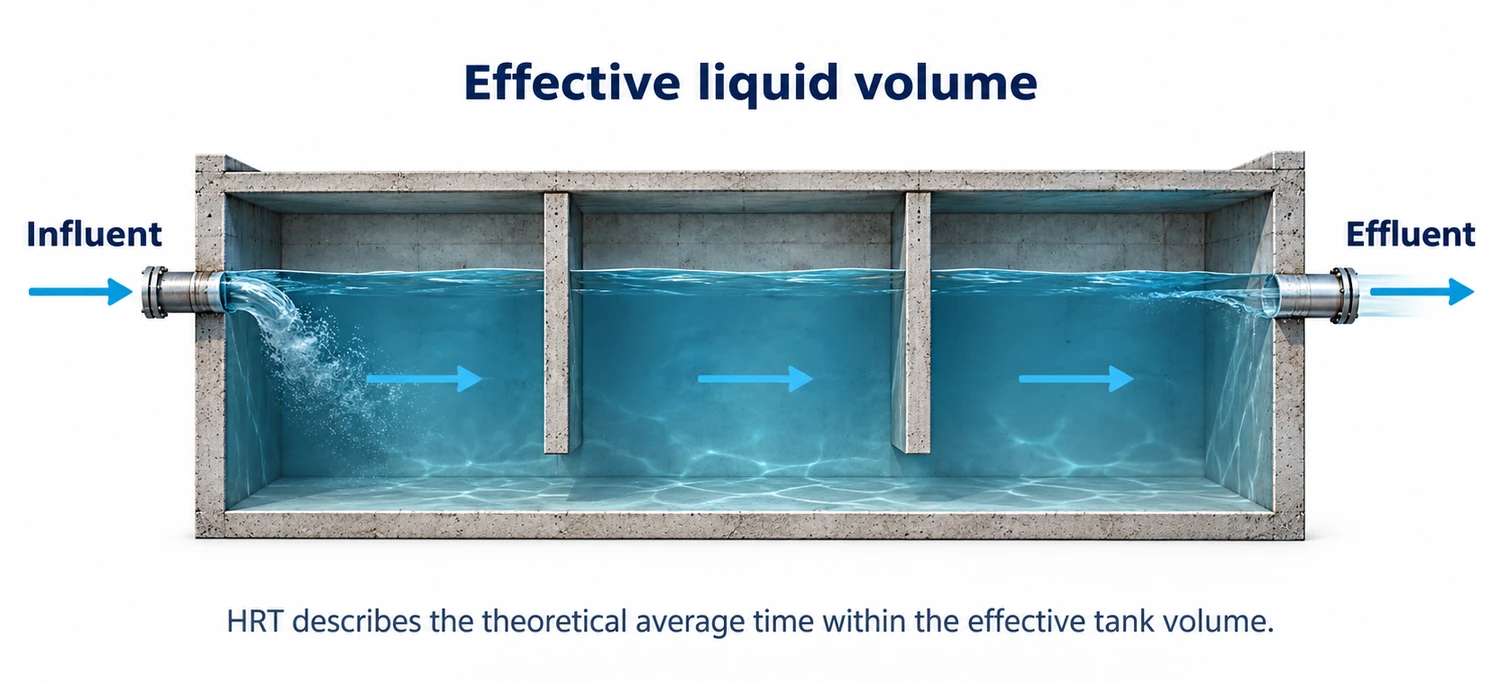
Hydraulic Retention Time (HRT), also called hydraulic residence time or detention time in many water-treatment applications, represents the theoretical average time that liquid remains in a treatment unit. It relates the usable liquid volume of a tank or reactor to the flow moving through it.
HRT is a fundamental planning and evaluation parameter for equalization tanks, biological reactors, contact tanks, sedimentation basins, and other treatment units. However, it does not directly measure how long every individual parcel of water remains inside a real tank.
2. Why Does HRT Matter?
Treatment processes need adequate contact or residence time for their intended mechanisms to occur. Depending on the system, this may involve mixing, chemical reaction, biological conversion, settling, disinfection, or temporary flow equalization.
An HRT that is too short may limit treatment or reduce robustness during peak flows. A longer HRT is not automatically better: excessive residence time can increase footprint, construction costs, stagnant conditions, or process-specific operational problems.
3. Where Is HRT Used?
Biological treatment
Hydraulic residence influences contact time between wastewater and biomass, but must be considered alongside solids retention time, organic loading, oxygen transfer, temperature, and reactor configuration.
Equalization and storage
Operating volume is generally determined from variations in inflow and outflow rather than by selecting a fixed detention time alone.
Sedimentation and clarification
Detention time is a useful hydraulic check, while clarification also depends on surface overflow rate, solids loading where applicable, inlet/outlet geometry, settling characteristics, and sludge handling.
Chemical contact and disinfection
Nominal HRT is not equivalent to verified contact time. Short-circuiting, mixing conditions, and applicable contact-time or disinfection requirements must also be assessed.
4. What Influences the Effective HRT?
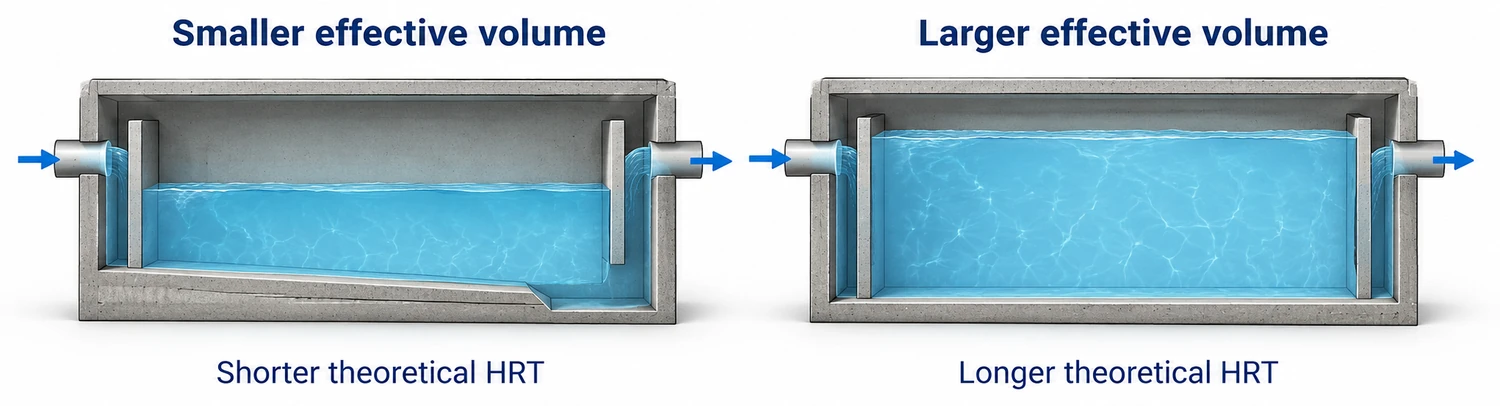
Effective tank volume
The useful liquid volume depends on normal operating water level, tank geometry, internals, sludge or media displacement, and unusable zones. Gross civil tank dimensions may therefore overstate the volume actually available for treatment.
Flow variation
As the flow entering a fixed-volume tank increases, the theoretical residence time decreases. Engineers should check the operating scenarios relevant to process performance rather than relying on a single average-flow condition.
Hydraulic distribution
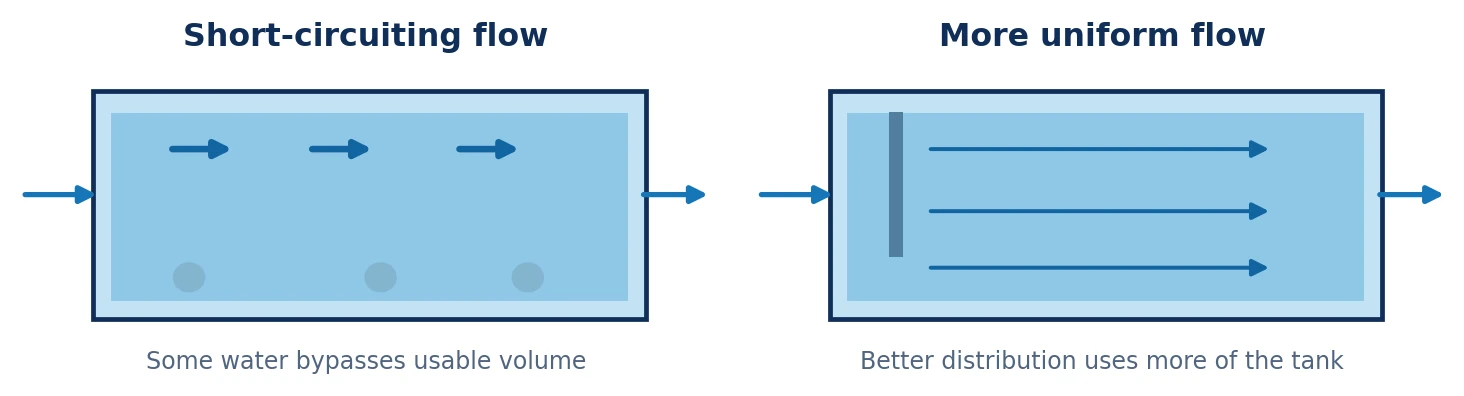
Inlets, outlets, baffles, mixing equipment, and tank shape determine how water travels through the unit. Poor distribution can cause short-circuiting and dead zones, so actual hydraulic contact can differ considerably from the nominal HRT.
5. Practical Steps for HRT Evaluation
6. HRT Versus Other Design Parameters
7. Common Design Mistakes
8. Conclusion
Hydraulic Retention Time is a useful starting point for evaluating how much residence time a treatment tank provides, but it is not a complete measure of process performance. The most reliable designs connect HRT to the intended treatment mechanism, effective working volume, relevant operating flow, and actual hydraulic behavior.
For practical engineering design, nominal residence time should be treated as one criterion within a broader assessment of process performance, operational flexibility, and applicable project requirements.
Engineering References
- Metcalf & Eddy / AECOM. Wastewater Engineering: Treatment and Resource Recovery. McGraw-Hill Education.
- Crittenden, J. C., et al. MWH’s Water Treatment: Principles and Design. Wiley.
- American Water Works Association (AWWA) / American Society of Civil Engineers (ASCE). Water Treatment Plant Design.
- U.S. Environmental Protection Agency (EPA). Disinfection Profiling and Benchmarking Guidance Manual. Discussion of hydraulic contact time and baffling.
This article is intended for engineering education and preliminary evaluation only. It does not establish process-specific minimum design criteria. Final sizing and performance verification should follow applicable standards, site data, project requirements, and qualified engineering review.